Physical Address
304 North Cardinal St.
Dorchester Center, MA 02124
Physical Address
304 North Cardinal St.
Dorchester Center, MA 02124

Network Functions Virtualization is an architecture that provides a way to decouple the network functionality from proprietary hardware and use it on the virtualized standard IT hardware or on cloud-based architecture.
It is developed by the European Telecommunications Standards Institute (ETSI). NFV architecture is used to transform the telecom industry by lowering Total Cost of Ownership (TCO), fast innovation and deployment, and by providing Scale-out / Scale-in functionality during special traffic hours.
ETSI created the Network Functions Virtualization Industry Specification Group (ISG) to define the requirements and architecture to address the below technical challenges:
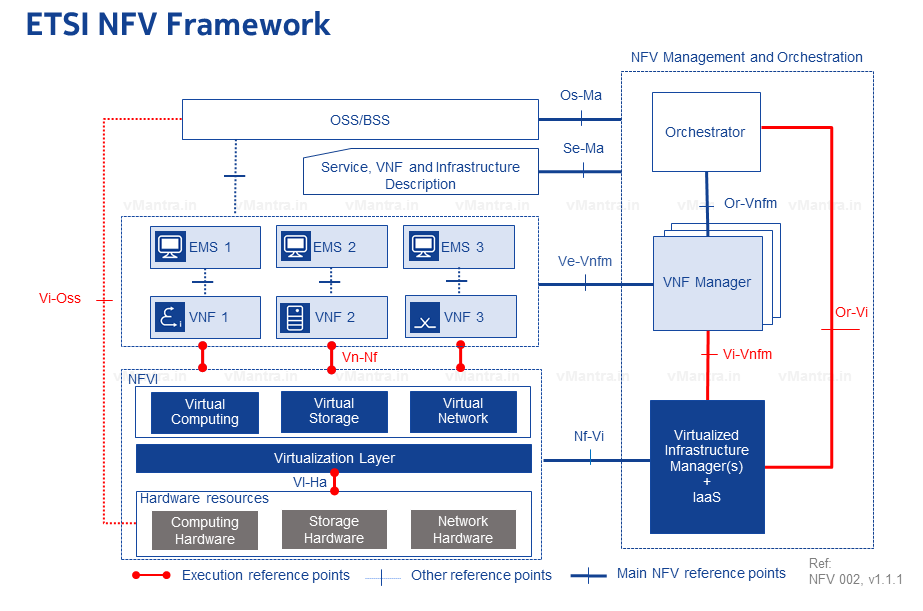
It consists of three main building blocks:
The Network Functions Virtualization Infrastructure (NFVI) is the foundational layer of NFV. Physical servers, storage arrays and networking nodes like router, switches, and firewall etc. are part of it. Also by using a hypervisor (like VMware ESXi, KVM etc.), it provides the virtual compute, storage, and network infrastructure on which the VNFs are deployed and executed.
The virtual infrastructure can be obtained by using some virtualization technologies, for example:
NFVI nodes can be deployed in multiple sites and zones to provide high-availability services and to support workload requirements. Operators can choose standard hardware from their preferred vendors like HPE, DELL, IBM, Cisco, Juniper etc. at competitive prices and upgrade hardware independently from workloads.
Management and Orchestration (MANO) covers the orchestration and management of infrastructure resources both hardware or software. MANO can be further divided into three components:
Virtualized Infrastructure Manager (VIM) is responsible for managing and monitoring of NFVI compute, storage, and network resources. It exposes this functionality northbound to VNFM and NFV Orchestrator so that they can deploy and manage VNFs. It also exposes the same functionality southbound to the hypervisors and SDN controllers in the NFVI. VIM also maintains the inventory of NFVI. The VIM provides the API that allows the VNFM to manage the complete lifecycle of all of the VNFs. VMware vCenter is a good example of Virtual Infrastructure Manager (VIM).
Virtual Network Functions Manager (VNFM) or VNF Manager is used to controlling, managing and monitoring the VNFs lifecycle. It also controls Element Management System (EMS) or/and Network Management System (NMS). VNF Manager works under control of NFV Orchestrator. Some of VNFM key responsibilities are:
Network Functions Virtualization Orchestrator (NFVO) or NFV Orchestrator is mainly responsible for onboarding of VNFs and Network Services those are managed by same or different VNF Managers and part of same or different NFVI.
NFVO communicates with the VIMs directly through their northbound interface, and coordinates, authorizes, releases and engages the virtual compute, storage and networking resources among single or multiple datacenters globally. This function is also called Resource Orchestration.
The second function of Network Functions Virtualization Orchestrator is Service Orchestration that is used to manage the life cycles of Network Services and VNFs. It provides the below functionalities:
In Conclusion, Network Functions Virtualization is a big evolution in technology. It provides organizations with an opportunity to simplify and automate their network infrastructure with less Total Cost of ownership (TCO). With Network Functions Virtualization, businesses can reduce costs, increase agility and scalability, and improve service quality. Organizations should evaluate the benefits of Network Functions Virtualization to determine if it will offer them a competitive advantage for their unique business needs.
Thanks 🙂
Kindly share it if you liked it….
Check out some more blogs:
advantages of network function virtualization, network function virtualization architectures, network function virtualization examples, network function virtualization, virtual machines, network operations, dedicated hardware